Establish your non-profit organization with full legal compliance. Dedicated to social welfare, education, and charity, with tax benefits and transparent governance.

Complete non-profit incorporation and compliance solutions designed for NGOs, foundations, and social entrepreneurs.
(Ideal for new non-profits and NGOs)
(Most recommended plan)
(Compliance & IP Starter)
(All-in-one business & compliance solution)
A Section 8 Company is a special type of non-profit organization registered under the Companies Act, 2013 with the objective of promoting charitable activities such as education, social welfare, healthcare, environmental protection, arts, culture, and rural development. Unlike regular companies, a Section 8 Company does not distribute profits among its members. Instead, all earnings and income are reinvested to support the organization’s mission and social objectives.
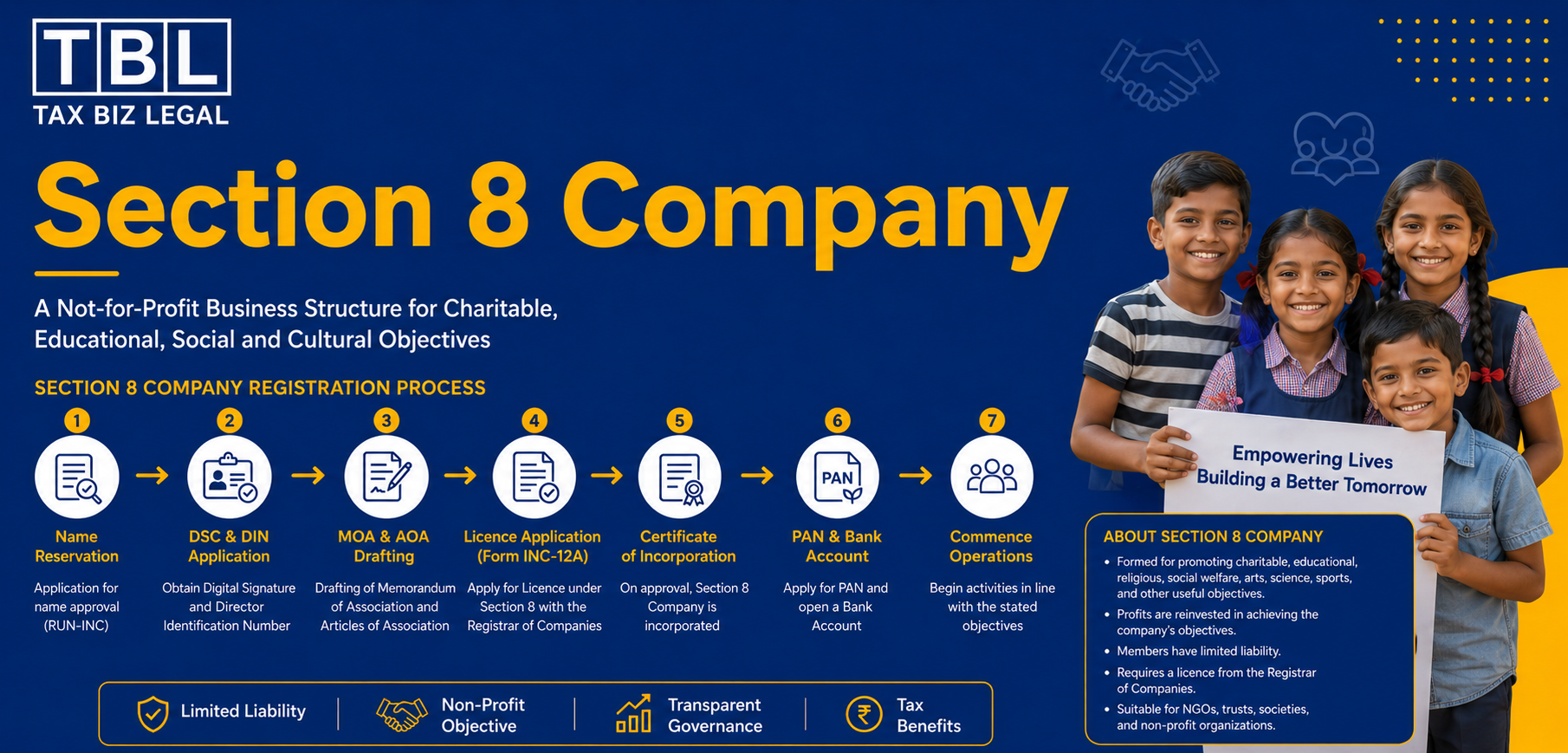
Section 8 Company registration is one of the most trusted legal structures for NGOs, charitable institutions, foundations, and non-profit organizations in India. It offers benefits such as limited liability protection, separate legal identity, better credibility, tax exemptions, and easier fundraising opportunities from donors, government bodies, and CSR initiatives. The registration process involves obtaining DSC and DIN, name approval, drafting MOA & AOA, filing incorporation forms, and obtaining the Section 8 License from the Registrar of Companies (ROC). With strong legal recognition and transparent governance, a Section 8 Company is an ideal choice for organizations working towards social impact and community development.
A Section 8 Company offers several advantages for individuals and organizations looking to work towards charitable, educational, social, cultural, or non-profit objectives. One of the biggest benefits is its separate legal identity, which allows the organization to own property, enter contracts, and operate independently from its members. It also provides limited liability protection, ensuring that the personal assets of directors and members remain protected from business liabilities and obligations.
Another major advantage of a Section 8 Company is the high level of credibility and trust it enjoys among donors, government authorities, CSR contributors, and financial institutions. Since profits cannot be distributed among members and must be used only for promoting social objectives, it creates greater transparency and accountability. Section 8 Companies may also enjoy tax benefits and exemptions under the Income Tax Act, subject to registration approvals. Additionally, they have better opportunities to receive donations, grants, and foreign funding compared to many other non-profit structures. With strong legal recognition, professional governance, and long-term sustainability, a Section 8 Company is an ideal structure for NGOs, charitable foundations, educational institutions, and social welfare organizations in India.
A Section 8 Company is governed by the provisions of the Companies Act, 2013 and is regulated by the Ministry of Corporate Affairs (MCA). It is specifically formed for promoting charitable and non-profit objectives such as education, social welfare, environmental protection, healthcare, religion, arts, culture, sports, and other activities that benefit society. Unlike regular companies, a Section 8 Company is prohibited from distributing profits or dividends among its members, and all income must be utilized solely for achieving its stated objectives.
The registration process of a Section 8 Company is carried out through the Registrar of Companies (ROC) and requires approval under Section 8 of the Companies Act. The incorporation involves obtaining Digital Signature Certificates (DSC), Director Identification Numbers (DIN), name approval, drafting the Memorandum of Association (MOA) and Articles of Association (AOA), and filing incorporation forms along with the Section 8 License application. Once approved, the company receives a Certificate of Incorporation and gains the status of a legally recognized non-profit entity. Section 8 Companies are also required to comply with annual filings, financial reporting, board meetings, and other statutory obligations to maintain transparency and legal compliance. This robust legal framework ensures accountability, credibility, and long-term sustainability for charitable organizations operating in India.
Section 8 Companies can be established for different charitable and non-profit purposes depending on the objectives of the organization. Below are some common types of Section 8 Companies in India:
These Section 8 Companies work for public welfare activities such as poverty relief, food distribution, shelter support, and social upliftment programs for underprivileged communities.
Formed for promoting education, skill development, literacy programs, research activities, coaching centers, schools, colleges, and educational awareness initiatives.
These organizations focus on healthcare services, medical camps, blood donation drives, awareness programs, hospitals, mental health support, and affordable treatment initiatives.
Established to promote environmental sustainability, tree plantation drives, waste management, wildlife protection, water conservation, and climate awareness campaigns.
These Section 8 Companies support cultural heritage, music, dance, art, literature, and preservation of traditional values and cultural activities.
Created to encourage sports activities, athlete development, fitness awareness, rural sports programs, and training academies for different sports categories.
These organizations work for religious welfare, spiritual education, community service, charity events, and maintenance of religious institutions.
Focused on women empowerment, child welfare, senior citizen support, disability assistance, rural development, and overall community improvement programs.
These Section 8 Companies are formed for scientific research, innovation, technology development, policy research, and public-interest studies.
Many Section 8 Companies are established specifically to implement Corporate Social Responsibility (CSR) activities and manage social impact projects for businesses and corporations.
Registering a Section 8 Company in India requires fulfilling certain legal conditions and documentation requirements under the Companies Act, 2013. Below are the essential requirements for incorporation:
The organization must be formed for promoting:
The proposed name must be unique and approved by the Ministry of Corporate Affairs (MCA). Common words used include:
All directors must obtain a valid Digital Signature Certificate (DSC) for filing registration documents online.
Every director must have a valid Director Identification Number (DIN) issued by the MCA.
A valid business address in India is required along with:
Required documents include:
Approval under Section 8 of the Companies Act, 2013 must be obtained from the Registrar of Companies (ROC).
The incorporation application is filed through the SPICe+ Form on the MCA portal along with required declarations and documents.
The company cannot distribute profits among members or directors. All income must be used for social or charitable purposes only.
After incorporation, the company must comply with:
TaxBizLegal provides complete assistance for Section 8 Company registration, documentation, name approval, ROC filing, and compliance management to help you start your NGO or non-profit organization legally and efficiently.
To register a Section 8 Company in India, certain documents are required for directors, members, and the registered office address. At TaxBizLegal, we help you prepare and verify all documents for smooth and hassle-free NGO registration.
A self-attested copy of the PAN Card is mandatory for all Indian directors and members involved in the Section 8 Company registration.
Any one of the following identity proofs is required:
Recent address proof of directors and members is required, such as:
The document should not be older than 2 months.
Recent passport-size photographs of all proposed directors and members are required for documentation purposes.
The company must provide proof of its registered office address, such as:
If the registered office is rented or owned by another person, an NOC from the property owner is required.
All directors must obtain a valid Digital Signature Certificate (DSC) for filing registration documents online.
DIN is required for all proposed directors of the Section 8 Company.
The MOA must clearly define the charitable objectives and activities of the organization.
The AOA contains the internal rules, governance structure, and operational guidelines of the Section 8 Company.
Directors and subscribers are required to submit consent declarations and incorporation-related forms as prescribed under the Companies Act, 2013.
Details regarding the proposed charitable activities, funding sources, and estimated income may be required during the registration process.
TaxBizLegal provides complete assistance with document preparation, verification, DSC & DIN application, MOA/AOA drafting, and ROC filing for fast and compliant Section 8 Company registration in India.
A Section 8 Company is a legally recognized non-profit organization registered under the Companies Act, 2013 for charitable and social welfare activities. While it offers several benefits such as credibility, limited liability, and tax advantages, it is also important to understand the registration costs, annual compliance expenses, and penalties for non-compliance. At TaxBizLegal, we help organizations manage both incorporation and ongoing compliance efficiently.
The cost of registering a Section 8 Company may vary depending on the number of directors, professional fees, and government charges. The registration package generally includes:
The overall cost may also depend on additional services such as PAN, TAN, GST registration, 12A & 80G registration, and NGO compliance support.
After incorporation, a Section 8 Company must comply with various legal and statutory requirements, including:
Proper compliance helps maintain the legal status and credibility of the organization.
Failure to comply with MCA and statutory regulations can result in heavy penalties and legal consequences. Common penalties include:
Delay in filing annual returns or financial statements attracts additional government fees and penalties on a daily basis.
Directors may face penalties or disqualification for continuous non-compliance or incorrect filings.
If the company violates the conditions of Section 8 registration or misuses funds, the government may revoke the Section 8 license.
Non-maintenance of proper records, false declarations, or misuse of charitable funds can lead to legal proceedings and monetary fines.
Failure to maintain proper compliance may result in cancellation of tax exemptions and benefits under the Income Tax Act.
Non-compliance may negatively affect donor trust, CSR funding opportunities, government grants, and NGO credibility.
TaxBizLegal provides complete support for Section 8 Company registration, annual ROC compliance, accounting, filing, audit coordination, and legal advisory services to help your NGO or non-profit organization remain fully compliant and legally secure.
Every Section 8 company must appoint its first auditor within 30 days of incorporation to ensure proper financial reporting and transparency.
A dedicated business account is required to manage all NGO transactions, donations, and capital deposits.
Establish clear internal governance rules regarding membership, voting rights, and the utilization of funds for charitable objects.
The company must affix its name board outside the registered office and mention the Corporate Identification Number (CIN) on all official letterheads and documents.
Confirm the receipt of the subscribed capital from members by filing this mandatory declaration with the ROC.
Apply for tax exemption status to ensure the NGO's income is tax-free and donors can claim deductions on their contributions.
Mandatory annual filing of income tax returns specifically designed for non-profit entities and trusts.
Submit mandatory forms AOC-4 (Financial Statements) and MGT-7 (Annual Return) to the Registrar of Companies every financial year.
Conduct regular meetings to discuss social impact, financial health, and future objectives of the organization.
Selecting the right type of business registration is a critical decision that affects your legal liability, taxation, compliance requirements, and ability to raise funds. Here’s a simplified and clear comparison of the most popular business structures in India to help you make an informed choice:
| Feature | Pvt Ltd | LLP | Sole Proprietorship | Partnership Firm | OPC |
|---|---|---|---|---|---|
| Ownership | Minimum 2, Maximum 200 shareholders | Minimum 2 partners | Single owner | Minimum 2 partners | Single owner |
| Legal Status | Separate legal entity | Separate legal entity | No separate legal entity | No separate legal entity | Separate legal entity |
| Liability | Limited to share capital | Limited liability | Unlimited liability | Unlimited liability (except LLP-type protection not available) | Limited liability |
| Registration | Mandatory with MCA | Mandatory with MCA | Not mandatory (can start easily) | Optional (but recommended) | Mandatory with MCA |
| Compliance | High (annual filings, audits) | Moderate compliance | Very minimal | Minimal compliance | Moderate compliance |
| Taxation | Corporate tax applicable | Taxed as partnership | Taxed as individual | Taxed as partnership | Corporate tax applicable |
| Funding | Easy to raise funds, investors prefer | Limited funding options | Difficult to raise funds | Limited funding options | Limited compared to Pvt Ltd |
| Ideal For | Startups & growing businesses | Professionals & service firms | Small local businesses | Small businesses with partners | Solo entrepreneurs planning to scale |
If you're planning to start a business and unsure which structure suits you best, TaxBizLegal can guide you through the entire registration process with expert support and end-to-end compliance assistance.
Speak with an Expert NowFind quick answers to common queries about Section 8 Company registration and NGO compliance in India.
Get Expert NGO HelpTaxBizLegal supports non-profits, NGOs, and social entrepreneurs across India with reliable and structured Section 8 Company registration services. Our goal is to simplify the non-profit incorporation process while ensuring compliance with applicable laws and regulations.
We assist you through each step of the registration process, including name approval, preparation of MOA & AOA, SPICe+ filing, DSC, DIN, PAN, and TAN. Our team works with qualified professionals to help ensure accurate documentation and smooth processing for your NGO.
While timelines may vary depending on document readiness and government approvals, we aim to complete the incorporation process as efficiently as possible by maintaining proper documentation and timely follow-ups.
Our pricing is structured to be transparent. The total cost depends on government fees, stamp duty, and service scope, which are shared clearly before starting the process.
A support representative is assigned to guide you throughout the registration journey—from document collection to incorporation updates—via call, email, or WhatsApp.
We also offer post-incorporation compliance support such as annual filings (AOC-4, MGT-7), auditor appointment (ADT-1), DIR-3 KYC, and income tax return filing, based on your requirements.
Services like 12A & 80G registration, CSR-1 filing, NGO Darpan, and trademark filing can be availed along with incorporation for added convenience.
We provide guidance on regulatory requirements applicable to foreign directors or members, including documentation and compliance processes as per Indian laws.
To minimize the risk of technical errors or government rejections, every application is cross-verified by our team of in-house Chartered Accountants and Company Secretaries before submission.
We guide eligible Section 8 companies through registrations needed for tax exemptions and CSR funding eligibility, helping you access grants and community support.
All your incorporation documents, such as the Certificate of Incorporation, MOA, and AOA, are stored in a secure digital environment, providing you with easy access whenever needed.
Incorporate your social venture from anywhere in the world. Our streamlined electronic process eliminates the need for physical visits and complex manual paperwork.
We provide expert guidance on charitable objectives and governance structuring to ensure your company is optimized for long-term social impact.
Need guidance before getting started? You can connect with our team for an initial consultation to understand the registration process, documentation, and compliance requirements—so you can make an informed decision.
Get Free Consultation Now