Empower solo entrepreneurs with a full-fledged corporate legal structure. Gain limited liability protection and build brand credibility in just 7 days.
Empower solo entrepreneurs with a full-fledged corporate legal structure and compliance solutions.
(Ideal for new solo founders)
(Most recommended plan)
(Compliance & IP Starter)
(All-in-one business & compliance solution)
A One Person Company (OPC) is a modern business structure introduced under the Companies Act, 2013, designed specifically for solo entrepreneurs who want to run their business with full control and limited liability protection. Unlike a traditional private limited company that requires multiple shareholders and directors, an OPC can be formed and managed by a single individual.
Launched to support startups, freelancers, consultants, and independent business owners, OPC registration allows a single founder to enjoy the legal status and credibility of a corporate entity while maintaining complete ownership of the company. Since the company is treated as a separate legal entity, the owner’s personal assets remain protected from business liabilities and financial risks.
One of the key requirements of an OPC is the appointment of a nominee, who will take over the company in case the owner becomes incapable of managing the business or passes away. An OPC also enjoys several compliance relaxations, including fewer procedural requirements, reduced board meeting obligations, and exemptions from certain annual formalities, making it easier to manage compared to other company structures.
Additionally, there is no mandatory minimum paid-up capital requirement, and the business can later be converted into a private limited company as it grows. Today, all OPC incorporation applications are processed online through the MCA portal by the Central Registration Centre (CRC), ensuring a faster and more streamlined registration process across India.
The rules governing OPC registration were simplified through the Companies (Incorporation) Amendment Rules, 2021, making it easier for individuals and NRIs to start a company in India.
Starting an OPC offers several advantages for solo business owners who want professional recognition with simplified management.
The liability of the owner is limited only to the amount invested in the company. Personal assets remain protected from business debts and legal claims.
An OPC has its own legal existence separate from its owner, allowing it to own property, open bank accounts, enter contracts, and operate professionally.
Since there is only one owner, all business decisions can be taken quickly without conflicts between partners or shareholders.
An OPC structure increases trust among clients, vendors, financial institutions, and investors compared to proprietorship businesses.
Compared to private limited companies, OPCs enjoy fewer compliance requirements and reduced procedural formalities.
The company continues to exist even if the owner becomes incapacitated, thanks to the nominee system.
OPCs can later be converted into private limited companies when the business expands and additional investment or shareholders are required.
Being a corporate entity, an OPC is looked upon more favorably by financial institutions, making it easier to secure business loans and credit facilities.
The mandatory appointment of a nominee provides a clear, legally-binding path for business continuity, protecting the legacy of your brand.
Starting a One Person Company (OPC) in India requires submitting a set of documents related to the sole member/director, nominee, and registered office address. At TaxBizLegal, we simplify the entire OPC registration process and help you prepare, verify, and file all required documents accurately for quick incorporation approval.
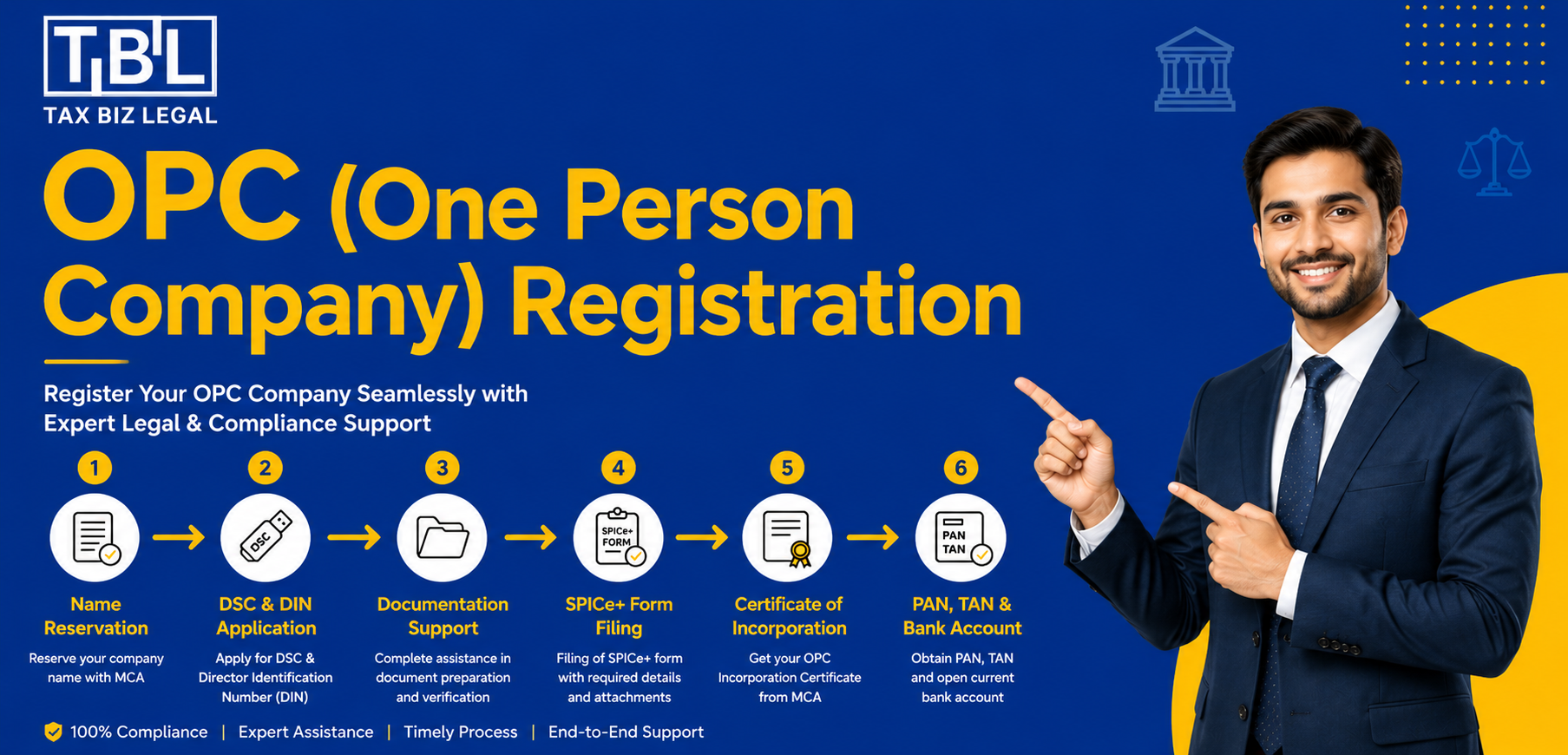
Registering an OPC is a streamlined digital process primarily managed through the Ministry of Corporate Affairs (MCA) SPICe+ platform. The entire journey from application to incorporation generally spans 10 to 15 business days.
The foundation of any digital filing is the Class 3 DSC. Since an OPC has only one director, we secure this immediately to allow for electronic signing. Crypto-tokens are dispatched within 24 hours of approval.
The name must be unique and end with "(OPC) Private Limited." We perform comprehensive database and trademark searches to avoid delays before submitting your preferred choices.
We draft MOA/AOA, Nominee Consent (INC-3), and Director Declaration (INC-9). We pre-fill SPICe+ Part B and AGILE-PRO-S covering GST, social security, and bank account setup.
Submission to the Central Registration Centre (CRC) triggers the automatic allotment of your Director Identification Number (DIN), eliminating separate filing requirements.
CRC officers examine every detail. We manage clarify requests or "Resubmissions" instantly. Constant monitoring ensures the 15-day timeline stays on track.
MCA grants the COI containing your Corporate Identity Number (CIN). Simultaneously, PAN/TAN are generated and social security registrations (EPFO/ESIC) are activated.
By the end of the 15-day window, your business is legally "born" with a complete compliance folder:
| Document Type | Description |
|---|---|
| COI & CIN | Your official "Birth Certificate" for the business. |
| PAN & TAN | Essential for tax filing and banking operations. |
| DIN & DSC | Your digital credentials as a Company Director. |
| MOA & AOA | The legal charter and rulebook of the company. |
| KYC Pack | A verified set of director documents for future use. |
When you're building a business alone, your legal structure is the "DNA" that determines how much you pay in taxes, how much paperwork you handle, and whether your personal bank account is safe if things go sideways. The choice usually boils down to three paths: staying lean as a Sole Proprietorship, getting corporate protection as an One Person Company (OPC), or preparing for massive scale with a Private Limited Company (PLC).
| Feature | Sole Proprietorship | One Person Company (OPC) | Private Limited Company |
|---|---|---|---|
| Legal Identity | Part of the owner | Independent entity | Independent entity |
| Asset Protection | None (Unlimited liability) | High (Limited liability) | High (Limited liability) |
| Team Size | Just you | 1 Member + 1 Nominee | Min. 2 Directors/Shareholders |
| Compliance | Minimal (Tax filing) | Moderate (ROC filings) | High (Audits & Meetings) |
| Taxation | Individual tax rates | Flat corporate rates | Flat corporate rates |
| Capital Growth | Personal / Bank Loans | Limited debt options | High (Equity/VC friendly) |
This is the default for most freelancers and local vendors. It’s the cheapest to start and requires almost no maintenance. However, the lack of a "corporate veil" means you and the business are one; if the business is sued or owes money, your personal savings and assets can be seized to pay the debt.
Ideal for: Low-risk service providers, consultants, and test-marketing a new idea.
The OPC was designed specifically for the modern solopreneur. It gives you the "Private Limited" status—protecting your personal assets—without requiring you to find a co-founder just to fill a legal quota. It carries more prestige than a proprietorship but involves annual filings with the Registrar of Companies (ROC).
Ideal for: Solo founders who want professional credibility and liability protection.
If your goal is to build the next "unicorn" or bring on partners, this is the only real option. Venture Capitalists and Angel Investors rarely fund anything else. It is the most complex to manage, requiring mandatory audits and board meetings, but it offers the most robust framework for splitting equity and raising millions.
Ideal for: Startups planning to raise outside capital or scale with a co-founding team.
While the One Person Company (OPC) offers great flexibility for solo founders, it isn't a "catch-all" structure. The law intentionally limits the scope of an OPC to keep its regulatory burden low and prevent its misuse for complex financial maneuvering.
If you are planning your business model, you must ensure your intended operations don't collide with these statutory "no-go zones."
An OPC is strictly prohibited from carrying out Non-Banking Financial Investment activities. This includes the business of investment in shares, stocks, bonds, or other securities of any body corporate. If your goal is to start a hedge fund or a private investment vehicle, the OPC is off-limits.
You cannot convert an OPC into a Section 8 (Non-Profit) company. The OPC structure is designed for-profit commercial ventures. If your primary objective is social welfare or charity, you must incorporate as a Section 8 company from the start.
The law requires the "Member" and the "Nominee" to be natural persons who are Indian citizens and residents. A minor is legally barred from becoming a member or nominee of an OPC or even holding shares with beneficial interest.
To prevent a single individual from creating a web of solo entities, a person is only allowed to incorporate one OPC or be a nominee in one OPC at any given time.
These boundaries are etched in the Companies Act, 2013, and unlike internal company rules, they cannot be bypassed by simply amending your Articles of Association (AOA).
Registering your One Person Company is just the first step of the journey. To keep your "Separate Legal Entity" status in good standing and avoid heavy-duty fines, you must adhere to a strict calendar of statutory filings. Think of these as the "maintenance checks" required to keep your corporate engine running legally.
Below is the essential breakdown of the annual milestones every OPC founder must hit:
| Requirement | Purpose of Filing | Typical Deadline | Consequence of Delay |
|---|---|---|---|
| Financial Transparency (AOC-4) | Submitting your audited balance sheet and P&L statement. | Within 180 days of Financial Year end | ₹100 per day (No limit) |
| Annual Snapshot (MGT-7A) | An abridged annual return specifically for OPCs and small firms. | 60 days after financial finalization | ₹100 per day (No limit) |
| Statutory Auditor (ADT-1) | Formalizing the appointment of your auditor for a 5-year block. | 15 days from the 1st Board Meeting | Escalating late fees |
| Identity Verification (DIR-3 KYC) | Annual re-verification of the Director’s credentials. | By 30 September | ₹5,000 + DIN Deactivation |
| Debt Reporting (DPT-3) | Declaring any outstanding loans or exempted deposits. | By 30 June | ₹100 per day |
| Tax Filing (ITR-6) | Filing the company’s corporate income tax return. | By 31 October | Up to ₹10,000 + Interest |
For most ROC forms like the AOC-4 and MGT-7A, the penalty of ₹100 per day accumulates indefinitely. If you forget to file for a year, the fine alone could exceed your initial setup costs.
Missing your DIR-3 KYC doesn't just cost money; it deactivates your Director Identification Number (DIN), effectively freezing your ability to sign any legal documents for the company until the fine is paid.
While ROC filings are mandatory from day one, GST returns only become a recurring monthly or quarterly headache once your turnover crosses the statutory threshold (unless you opted for voluntary registration).
Many founders assume that because they are operating solo, they are locked out of the "big league" government incentives. On the contrary, an One Person Company (OPC) is legally recognized as a corporate entity, making it eligible for a suite of powerful fiscal and regulatory advantages designed to fuel entrepreneurial growth.
DPIIT recognition for innovation and improvement unlocks:
Udyam registration provides a corporate safety net including:
Lowered cost of entry for solo founders through:
Specific states offer aggressive startup policy support:
Choosing between an OPC and other structures is a critical decision. Use this comparison of popular Indian business structures to find your best fit:
Quick answers to common queries about One Person Company registration and compliance.
Get Expert HelpStarting a company is a huge milestone, but the legal paperwork can be overwhelming. At TaxBizLegal, we take the complexity out of the process so you can start your journey with confidence.
From getting your Director Identification Number (DIN) to receiving your final Certificate of Incorporation, we manage every step. You won't have to deal with multiple portals or confusing legal jargon.
We provide a 100% online process. There’s no need to visit a physical office; just upload your documents, and our team takes it from there.
We don't just register your company; we explain the rules. We help you understand your mandatory filings (like AOC-4 and MGT-7A) so you never face a penalty.
No hidden "professional fees" or surprise costs mid-way. We provide a clear breakdown of government fees and our service charges from day one.
Once your OPC is live, we are here to help with GST registration, Trademark filing, and your annual accounting needs.
We act as your dedicated legal department. While you focus on building your brand and finding customers, we ensure your business foundation is legally rock-solid.