A practical business structure that combines the flexibility of a partnership with the benefit of limited liability. Suitable for professionals, consultants, and growing businesses looking for a structured and compliant setup.

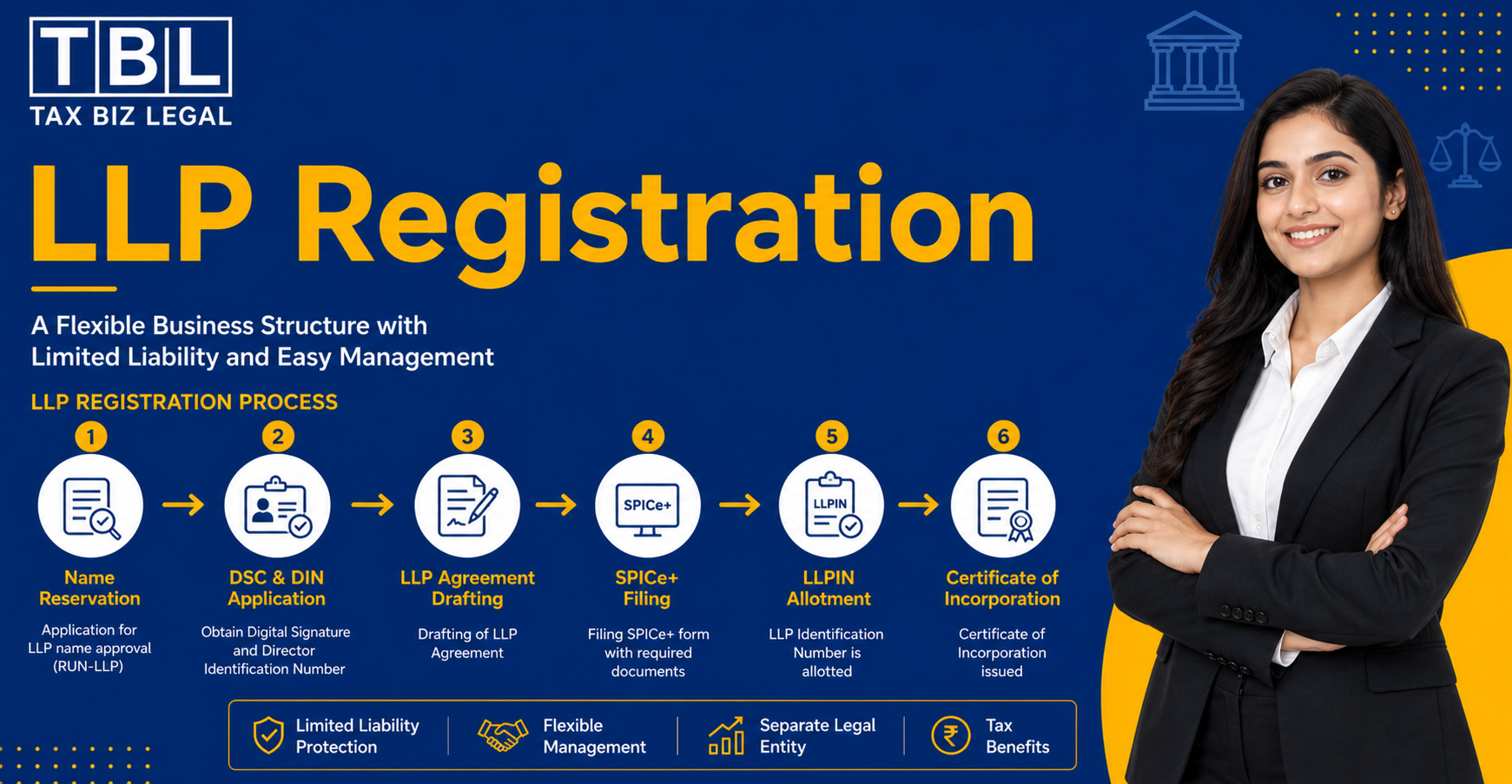
Complete Limited Liability Partnership incorporation and compliance solutions designed for professionals and growing teams.
(Ideal for new businesses and startups)
(Most recommended plan)
(Compliance & IP Starter)
(All-in-one business & compliance solution)
A Limited Liability Partnership (LLP) is a popular business structure in India that combines the advantages of both a partnership firm and a company. It offers partners the flexibility of organizing their internal management like a traditional partnership, while providing the benefit of limited liability, similar to a private limited company. This means the personal assets of the partners are protected from the liabilities of the business.
LLPs are governed by the Limited Liability Partnership Act, 2008, and are registered with the Ministry of Corporate Affairs (MCA). This structure is particularly well-suited for professionals, consultants, and service-based businesses such as Chartered Accountants, Company Secretaries, lawyers, architects, and IT consultants, who wish to operate as a collective entity without exposing their personal assets to business risks.
Key features of an LLP include its separate legal entity status, perpetual succession (meaning its existence is independent of its partners), and lower compliance requirements compared to a private limited company. It is an ideal choice for small to medium-sized enterprises looking for a structured, legally compliant, and growth-oriented business model.
Before starting the LLP incorporation process, it’s important to understand the various categories under which a Limited Liability Partnership can be formed. These classifications are designed to suit different business models, ownership structures, and operational requirements:
A Domestic LLP is the most popular choice for Indian residents and local businesses. It provides a robust legal framework with the benefit of limited liability, making it the standard model for service providers and small-scale manufacturers operating within the country.
Example: Two professionals in Mumbai forming an LLP to provide marketing or consulting services across India.
Ideal for international entities looking to establish a footprint in the Indian market. Whether through foreign direct investment or collaboration with Indian partners, this structure allows global businesses to operate locally while adhering to FEMA regulations.
Example: A US-based company collaborating with Indian partners to open an LLP in India for IT services.
Tailored for licensed experts such as CAs, Company Secretaries, Advocates, and Architects. This category enables professionals to collaborate and scale their practice with limited liability, ensuring their personal assets remain protected from business risks.
Example: A group of Company Secretaries forming an LLP to provide corporate compliance and advisory services.
Specifically designed for innovators and entrepreneurs. This structure offers high flexibility and is eligible for benefits under the Startup India scheme, making it easier for new-age businesses to scale with lower regulatory hurdles.
Example: A tech startup launching a SaaS product through an LLP structure.
A cost-effective solution for micro and small enterprises. With lower capital requirements and simplified compliance norms, this category empowers small traders and service providers to formalize their business without heavy administrative burdens.
Example: A small trading or service-based business operating locally with limited investment.
A strategic move for existing Partnership Firms or Private Limited Companies. By converting into an LLP, businesses can enjoy the security of limited liability and a more flexible operational structure while maintaining their established market presence.
Example: A traditional family-run partnership firm transitioning into an LLP for better legal protection.
While an LLP typically requires a minimum of two partners, specific regulatory provisions allow for temporary single-partner operations. This ensures business continuity during transitional periods or partner exits as per MCA guidelines.
Example: A business continuing operations as an LLP after one partner exits, within the allowed timeframe.
LLPs in India are governed by a structured legal system to ensure transparency and compliance:
Every LLP, once successfully registered, is issued a Certificate of Incorporation by the Ministry of Corporate Affairs, confirming its legal existence.
Before applying for LLP registration, it is essential to ensure that your business meets the legal requirements prescribed under the Limited Liability Partnership Act, 2008. At TaxBizLegal, we help you verify these conditions to ensure a smooth and hassle-free registration process.
To form a Limited Liability Partnership (LLP) in India, the following eligibility criteria must be fulfilled:
An LLP must have at least two partners at the time of incorporation. These can be individuals or corporate entities.
A minimum of two designated partners is mandatory, and they must be individuals. At least one of them should be a resident of India.
One designated partner must have stayed in India for at least 182 days during the immediately preceding financial year.
All partners and designated partners must be at least 18 years old to legally enter into an agreement.
There is no maximum limit on the number of partners in an LLP, making it flexible for growing businesses.
All designated partners must have a valid Digital Signature Certificate to sign electronic documents during the registration process.
Each designated partner must possess a valid Designated Partner Identification Number (DPIN) or Director Identification Number (DIN).
LLPs cannot be formed for charitable or non-profit purposes and must not operate in sectors restricted or prohibited by the government.
By meeting these requirements, you can ensure a legally compliant LLP registration process. TaxBizLegal provides complete assistance—from documentation to filing—so your business starts on a strong legal foundation without delays or penalties.
Before initiating the LLP incorporation process, it is important to keep all the necessary documents ready. Proper documentation helps in faster approval and avoids unnecessary delays during registration. Here’s a complete checklist to guide you:
Having all these documents in place ensures a smooth LLP registration process. With expert assistance from TaxBizLegal, you can complete documentation and filing efficiently while staying fully compliant with legal requirements.
Registering a Limited Liability Partnership (LLP) in India is now a fully online and hassle-free process. An LLP combines the benefits of a partnership firm with the protection of limited liability, making it an ideal choice for startups, professionals, and growing businesses. With the MCA online registration system, entrepreneurs can easily incorporate their LLP from anywhere in India with proper legal and compliance support.
Obtain Digital Signature Certificates (DSC) for the designated partners for secure electronic authentication.
Apply for Director Identification Numbers (DIN) for all proposed designated partners of the LLP.
Reserve the business name through the Ministry of Corporate Affairs (MCA) to ensure it is unique and available.
Submit the official incorporation forms along with required documents for verification by the Registrar.
Receive the Certificate of Incorporation from the MCA, which officially establishes your business as a legal entity.
Once registered, the LLP receives its PAN and TAN, allowing the business to operate legally and smoothly.
Professional assistance ensures accurate documentation, faster approvals, and complete end-to-end support throughout the registration process.
Registering an LLP in India involves certain government fees, professional charges, and compliance-related costs depending on the nature and scale of the business. The overall registration cost may include DSC charges, name approval fees, incorporation filing fees, stamp duty, and professional assistance charges. The fees can vary based on the state of registration and the contribution amount of the LLP.
Apart from registration expenses, LLPs are also required to comply with annual filing requirements under the Ministry of Corporate Affairs (MCA). Failure to file mandatory forms such as Form 8 and Form 11 within the due dates may attract heavy late filing penalties on a per-day basis. Maintaining timely compliance helps businesses avoid unnecessary legal complications, financial penalties, and disruptions in business operations.
Failure to comply with LLP registration rules and annual filing requirements may lead to heavy penalties, additional government charges, and legal consequences. Businesses must ensure timely filing of mandatory forms and accurate disclosure of information to avoid unnecessary fines and compliance issues.
A late fee of ₹100 per day may be charged, subject to applicable limits prescribed by MCA.
LLPs are liable to pay ₹100 per day until the form is successfully filed.
Penalties of ₹100 per day continue for the entire delay period.
Non-compliance with statutory provisions can attract penalties ranging from ₹1,000 to ₹5 lakhs depending on the offence.
Partners may face unlimited personal liability along with possible legal proceedings.
Submission of false documents or statements may result in penalties up to ₹5 lakhs and legal prosecution.
Both the LLP and the concerned partner may face fines up to ₹1 lakh.
Authorities may cancel the LLP registration and impose substantial penalties.
To understand the complete structure of government fees, compliance costs, and filing charges, businesses should review the detailed LLP registration fee guidelines applicable in India.
Incorporating an LLP is just the beginning of running a legally compliant business. After registration, every Limited Liability Partnership must follow the compliance rules laid down under the Limited Liability Partnership Act, 2008, and regulations issued by the Ministry of Corporate Affairs (MCA). Regular annual filings and timely reporting of important changes are mandatory to keep the LLP active and compliant with the Registrar of Companies (ROC). Failure to comply may result in continuous penalties and legal complications.
Every LLP in India is required to complete the following annual compliances:
LLPs must submit Form 11 to the ROC every year within 60 days from the end of the financial year, generally by 30th May. This form contains information related to partners, designated partners, and contribution details.
Form 8 must be filed annually by 30th October. It includes details regarding the financial condition and solvency status of the LLP for the financial year ending 31st March. LLPs exceeding the prescribed turnover or contribution limits may require certification from a Chartered Accountant.
All LLPs are required to file their income tax returns every year. The due date depends on whether the LLP is subject to audit under the Income Tax Act. LLP income is taxed according to the applicable tax provisions under Indian law.
If the LLP turnover crosses the prescribed threshold limits for business or professional income, a tax audit becomes compulsory under Section 44AB of the Income Tax Act. The audit report must be filed within the prescribed timeline.
LLPs registered under GST are required to file periodic GST returns such as GSTR-1, GSTR-3B, and annual returns based on their turnover and registration category.
Apart from yearly filings, certain business changes require immediate reporting to the ROC:
Any appointment, resignation, or change in partner details must be reported through the prescribed MCA forms within the specified time limit.
If any amendment is made to the LLP Agreement, the updated agreement must be filed with the ROC within the prescribed period.
LLPs changing their registered office address are required to inform the ROC through the appropriate filing procedure.
Defunct LLPs with no liabilities and pending compliances may apply for closure or strike-off through the MCA process.
Maintaining timely compliance helps LLPs avoid penalties, maintain legal status, and build trust among clients, financial institutions, and business partners.
Choosing a Limited Liability Partnership (LLP) can be a smart option for startups, professionals, and small businesses looking for a balance between operational flexibility and legal protection. An LLP offers several benefits such as reduced compliance requirements, separate legal identity, and protection of personal assets, making it one of the most preferred business structures in India.
An LLP protects the personal assets of partners from business-related debts and liabilities. Each partner’s liability is generally limited to the amount invested or agreed upon in the LLP.
LLPs enjoy a simplified taxation structure compared to companies. Profit distributed among partners is generally not subject to dividend distribution tax, helping businesses manage taxes more efficiently.
Compared to private limited companies, LLPs have fewer legal formalities and reduced compliance obligations. Audit requirements are applicable only when the business crosses the prescribed turnover or contribution limits.
An LLP can be started with any amount of capital as decided by the partners. There is no fixed minimum capital requirement for incorporation.
The LLP continues to exist irrespective of changes in partners. Admission, resignation, or death of a partner does not affect the continuity of the business.
Registering as an LLP improves credibility among customers, vendors, and financial institutions. It also helps businesses build a more professional identity in the market.
Partners can join or exit the LLP according to the terms mentioned in the LLP Agreement, making ownership management easier and more flexible.
LLPs offer a scalable business structure that can accommodate multiple partners and support future business growth across different industries and sectors.
A Limited Liability Partnership (LLP) comes with unique features that make it a preferred business structure for startups, professionals, and small businesses. It combines the operational flexibility of a partnership firm with the legal protection of a corporate entity.
The liability of each partner is restricted to the amount contributed by them in the LLP. Personal assets of partners remain protected from the debts and obligations of the business.
An LLP is treated as a separate legal entity from its partners. It can hold property, open bank accounts, enter into agreements, and initiate legal actions in its own name.
The LLP enjoys perpetual succession, meaning the business continues even if partners change due to resignation, retirement, death, or insolvency.
There is no compulsory minimum capital requirement for starting an LLP. Partners can decide the contribution amount and structure according to mutual understanding.
Partners have the flexibility to define management roles, profit-sharing ratios, rights, and duties through the LLP Agreement, allowing smooth internal operations.
LLPs are generally taxed only at the entity level, helping avoid additional dividend-related taxation and making them comparatively tax efficient.
LLPs have simpler compliance requirements than private limited companies, with fewer mandatory filings and relaxed audit rules for eligible businesses.
The LLP model supports business growth by allowing the addition of new partners without major procedural complications, making expansion easier and more manageable.
Still deciding on the right business structure? You can also explore our Company Registration services to find the best option for your business needs.
Selecting the right type of business registration is a critical decision that affects your legal liability, taxation, compliance requirements, and ability to raise funds. Here’s a simplified comparison to help you choose:
Find quick answers to common queries about LLP registration and legal compliance in India.
Get Expert HelpAt TaxBizLegal, we make LLP registration simple, fast, and completely hassle-free for startups, professionals, and growing businesses. Our experienced legal and compliance experts handle the entire process from name approval to incorporation filing with accuracy and transparency. We provide end-to-end assistance, ensuring all your documents are prepared correctly and submitted on time to avoid delays or rejections.
With affordable pricing, dedicated support, and a smooth online process, TaxBizLegal helps you register your LLP from the comfort of your home. We focus on timely service, clear communication, and complete compliance with MCA regulations. Whether you are starting a new business or converting an existing setup into an LLP, our team guides you at every step with expert consultation and reliable support.
Choose TaxBizLegal for trusted service, professional guidance, and a seamless LLP registration experience designed to help your business grow confidently.