FSSAI Registration

FSSAI Registration Made Simple

Get your FSSAI License or Registration quickly and easily with TaxBizLegal. Stay compliant and grow your food business with confidence.

FSSAI registration and food license support
Fast ProcessingGet your FSSAI license in 5 to 7 working days
100% OnlineHassle-free online registration process
Expert AssistanceEnd-to-end support from our experts
Affordable PricingClear pricing with no hidden charges

Food License Packages

Professional fee excluding government statutory charges

Basic Registration

(Turnover < ₹12 Lakhs)
₹999 + GST
  • FSSAI Form-A Filing
  • Document Preparation
  • Registration Certificate
  • Govt. Liaisoning
  • Business Activity Classification
  • Applicant KYC Review
  • FoSCoS Portal Application Support
  • Food Category Guidance
  • Application Status Tracking
  • Post-approval Certificate Download Help
Choose Plan

State License

(Turnover ₹12L - ₹20Cr)
₹2,999 + GST
  • FSSAI Form-B Filing
  • Expert Documentation
  • State License Certificate
  • Product Category Selection
  • Follow-up with Authority
  • Business Premises Document Review
  • Food Safety Management Plan Guidance
  • Manufacturing / Trading Category Mapping
  • Query Response Drafting Support
  • One Round Application Correction Support
  • Display and License Usage Guidance
Choose Plan

Central License

(Turnover > ₹20Cr or Imports)
₹4,999 + GST
  • Central FSSAI Filing
  • Import/Export Code Integration
  • Nomination of Nominee
  • Full-scale Compliance Pack
  • Dedicated Case Manager
  • Multi-state Operation Review
  • Importer / Exporter Category Guidance
  • Advanced Document Checklist
  • FoSCoS Central License Application Support
  • Department Query Coordination
  • License Display and Renewal Timeline Guidance
  • Priority WhatsApp and Email Assistance
Choose Plan

Understanding FSSAI License Registration in India

FSSAI License Registration is an official authorization issued by the Food Safety and Standards Authority of India (FSSAI) to food-related businesses. It certifies that the business complies with the food safety regulations and hygiene standards prescribed by the government.

Any individual or company involved in manufacturing, processing, packaging, storage, transportation, distribution, or sale of food products in India must obtain an FSSAI registration or license.

In Simple Words:

FSSAI is the government body responsible for regulating food safety in India.

It provides legal permission to operate a food business.

It ensures that food products are prepared and handled under proper hygiene and quality standards.

Almost every food business in India requires an FSSAI registration or license.

Categories of FSSAI License in India

Select the appropriate FSSAI license based on your business turnover and operations.

1. Basic FSSAI Registration

Basic FSSAI Registration is suitable for small-scale food businesses with an annual turnover of up to ₹12 lakhs. The registration number generally starts with the digit “1”.

Examples: Home-based food businesses, small vendors, or food stalls.

2. State FSSAI License

The State FSSAI License is required for medium-sized food businesses having an annual turnover between ₹12 lakhs and ₹20 crores. The license number usually begins with the digit “2”.

Examples: Restaurants, cafes, food shops, and medium-sized manufacturers.

3. Central FSSAI License

Large food businesses with an annual turnover above ₹20 crores must obtain a Central FSSAI License. This license is mandatory for large manufacturers, importers, exporters, and businesses operating in multiple states.

Examples: Large food processing companies, import/export businesses, and major food brands.

Benefits of FSSAI Registration in India

Let your food business thrive with these powerful FSSAI registration advantages:

1. Legality and Compliance

Operate with Legal Confidence: Run your business according to food safety laws, avoiding fines, penalties, and business interruptions.

Legal Authority: FSSAI registration proves that your business is legally authorized to manufacture, store, distribute, or sell food products in India.

2. Enhanced Customer Trust

Show Safety Commitment: Customers feel more confident purchasing from businesses that are approved by the Food Safety and Standards Authority of India (FSSAI).

Build Brand Loyalty: Trust in food safety encourages repeat customers and strengthens your brand reputation in the market.

3. Quality Assurance

Maintain Food Standards: FSSAI compliance ensures that your business follows proper hygiene, storage, and food safety standards.

Reduce Complaints and Recalls: Maintaining quality control minimizes the risk of contamination, spoilage, and customer complaints.

4. Improved Market Credibility

Gain Professional Recognition: An FSSAI license enhances your business credibility and gives your brand a more professional image.

Attract Business Opportunities: Retailers, distributors, restaurants, supermarkets, and online food platforms prefer working with FSSAI-registered businesses.

5. Legal Liability Protection

Show Due Diligence: Your FSSAI registration demonstrates that your business follows legally required food safety practices.

Protect Your Business Legally: In case of legal disputes or inspections, the license serves as proof of compliance and responsible business operations.

6. Streamlined Operations

Encourage Process Efficiency: FSSAI guidelines help businesses implement better food handling, packaging, storage, and operational systems.

Simplify Inspections and Audits: Registered businesses can handle government inspections and compliance checks more efficiently and professionally.
Who Can Apply for FSSAI License Registration in India?

The type of FSSAI license required for a food business depends on factors such as annual turnover, nature of activities, production capacity, and operational reach.

Basic FSSAI Registration

Applicable Turnover: Up to ₹12 lakh annually

Suitable For: Small-scale food businesses and petty food operators such as:

  • Street food vendors and hawkers
  • Home-based food businesses
  • Small retailers and shopkeepers
  • Cottage industries
  • Temporary food stalls

This registration is ideal for businesses operating on a very small scale with limited food handling activities.

State FSSAI License

Applicable Turnover: Between ₹12 lakh and ₹20 crore annually

Suitable For: Medium-sized food businesses operating within a single state, including:

  • Food manufacturers and processors
  • Storage units and warehouses
  • Transporters and distributors
  • Restaurants and catering businesses
  • Food marketers and traders

Businesses carrying out regular commercial food operations within one state generally require a State License.

Central FSSAI License

Applicable Turnover: Above ₹20 crore annually

Mandatory For: Certain businesses must obtain a Central License irrespective of turnover, including:

  • Food importers and exporters
  • Businesses operating in multiple states
  • E-commerce food platforms and aggregators
  • Units located at airports, seaports, railways, or central government premises
  • Large-scale food manufacturers and strategic food operations

For companies with nationwide operations, the head office usually requires a Central FSSAI License.

Important Guidelines Related to FSSAI Licensing

Multi-State Business Operations

Businesses operating in more than one state must obtain:

  • A Central License for the Head Office
  • Separate State Licenses or Registrations for each branch, warehouse, or unit located in different states

Capacity-Based Licensing Requirements

In specific industries such as:

  • Dairy processing
  • Meat processing
  • Edible oil manufacturing

Licensing eligibility may also depend on production capacity, even if turnover is below the standard threshold.

Special Rules for Transporters and Caterers

Transport businesses, catering services, and certain food service operators may fall under separate criteria and should verify the latest FoSCoS licensing guidelines.

Separate License for Each Premises

Every food business location—including manufacturing units, warehouses, offices, or retail outlets—must obtain its own individual FSSAI registration or license.

Businesses Required to Obtain FSSAI License Registration in India

Any individual or business involved in manufacturing, processing, storing, transporting, distributing, or selling food products in India must obtain an FSSAI Registration or License before commencing operations.

Food Manufacturing and Processing Businesses

FSSAI registration is mandatory for businesses involved in producing or processing food items, including:

  • Food manufacturing units and factories
  • Bakeries and confectionery units
  • Flour mills and oil mills
  • Packaged drinking water and beverage plants
  • Spice processing units
  • Food repacking, relabelling, and co-packing businesses
  • Third-party manufacturing and job-work units

Restaurants and Food Service Providers

Businesses serving prepared food to customers must obtain an FSSAI license, such as:

  • Restaurants and cafes
  • Hotels and resorts
  • Cloud kitchens and dark kitchens
  • Tiffin and meal delivery services
  • Catering companies
  • Food stalls, kiosks, and dhabas
  • Food trucks and canteens
  • Hostel and office mess facilities

Food Traders and Sellers

Food businesses involved in retail, wholesale, or online selling are also required to register under FSSAI, including:

  • Wholesalers and distributors
  • Supermarkets and grocery stores
  • Kirana shops and retail food outlets
  • Online food sellers and D2C brands
  • Sellers operating through e-commerce platforms
  • Delivery partners associated with food aggregators

Food Storage and Transportation Businesses

FSSAI licensing is necessary for businesses handling food storage and transportation activities, including:

  • Warehouses and godowns
  • Cold storage and cold chain facilities
  • Refrigerated transport operators
  • Food transportation and logistics companies

Importers and Exporters of Food Products

Businesses importing food products, raw materials, or ingredients into India—or exporting food items internationally—must obtain a Central FSSAI License.

Institutions and Organizations Supplying Food

Organizations that prepare or distribute food as part of public, charitable, or institutional services are also required to obtain FSSAI registration, including:

  • Schools and mid-day meal providers
  • Hospitals and healthcare institutions
  • Anganwadi centers
  • Religious trusts and charitable organizations
  • NGOs involved in food distribution programs

Step-by-Step Process for FSSAI License Registration in India

Follow the below process to apply for an FSSAI Registration or Food License online in India smoothly and efficiently.

Step 1: Choose the Appropriate FSSAI License Type

The first step is to identify the correct category of FSSAI registration applicable to your business based on turnover, business activities, and operational area.

Things to evaluate:

  • Annual business turnover
  • Nature of food business activities
  • Single-state or multi-state operations
  • Manufacturing, trading, storage, or service activities
  • Import or export involvement

Selecting the correct license category helps avoid application rejection or compliance issues later.

Step 2: Arrange Required Documentation

Prepare all supporting documents needed for your FSSAI application according to the type of registration or license required.

Common documents include:

  • Identity and address proof of business owners
  • Business registration certificates
  • Address proof of premises
  • Food safety management details
  • Product and manufacturing-related information
  • Regulatory and compliance certificates

Keeping documents accurate and updated ensures faster processing of your application.

Step 3: Submit the Online FSSAI Application

Apply through the official Food Safety Compliance System (FoSCoS) portal to complete the registration process online.

Application process includes:

  • Registering on the official FSSAI portal
  • Filling out the applicable application form
  • Entering business and operational details correctly
  • Uploading all required documents
  • Reviewing the application before final submission

Properly filled applications reduce delays and improve approval chances.

Step 4: Make Payment of Applicable Fees

After completing the application form, pay the prescribed FSSAI registration or license fee through the online payment system.

During payment:

  • Choose a suitable payment method
  • Complete the transaction securely
  • Save the payment acknowledgment receipt
  • Confirm payment status through the portal dashboard

Fee amounts vary depending on the type and validity of the license.

Step 5: Verification and Inspection Process

Once submitted, the application is reviewed by the food safety authorities. In certain cases, an inspection of the business premises may also be conducted.

Important points:

  • Monitor your application status online
  • Keep your premises ready for inspection if required
  • Respond promptly to clarification requests
  • Ensure compliance with hygiene and food safety standards

Proper compliance helps speed up the approval process.

Step 6: Obtain the FSSAI Registration Certificate

After successful verification and approval, the FSSAI Registration Certificate or License is issued digitally through the portal.

After receiving the certificate:

  • Download and print the certificate
  • Display it prominently at your business location
  • Mention the FSSAI number on packaging and invoices where applicable
  • Track the validity date for timely renewal

An active FSSAI license enhances business credibility and ensures legal food operations in India.

Get professional assistance for hassle-free FSSAI License Registration and compliance support for your food business in India.

Essential Documents Required for FSSAI Registration and Food License in India

To obtain an FSSAI Registration or License in India, applicants must submit specific documents based on the category of license they are applying for. The documentation requirements may differ for Basic Registration, State License, and Central License applications.

Common Documents Required for FSSAI Registration

The following documents are generally required for all categories of FSSAI applications:

  • Duly filled application form applicable to the license category
  • Identity proof of the applicant or business owner
  • Address proof of the business premises
  • Business constitution or registration proof
  • Recent passport-size photographs
  • Details of food products or categories handled by the business
  • Signed declaration and undertaking form

These documents help verify the identity, legitimacy, and operational details of the food business.

Documents Required for Basic FSSAI Registration

Small food businesses and petty food operators applying for Basic Registration typically need the following:

  • Name and address details of the proprietor
  • Aadhaar Card, PAN Card, Voter ID, or other valid identity proof
  • Passport-size photograph of the applicant
  • Self-declaration or undertaking form

This category is suitable for businesses operating on a small scale with limited annual turnover.

Documents Required for State FSSAI License

Businesses applying for a State FSSAI License must provide more detailed business and operational documentation, including:

  • Completed application form with business information
  • Partnership deed, LLP agreement, or Certificate of Incorporation
  • Layout or blueprint of the manufacturing or processing unit
  • List of machinery and equipment installed
  • Water testing or analysis report, where applicable
  • Food Safety Management System (FSMS) plan
  • List of directors, partners, or proprietors with ID and address proof
  • No Objection Certificate (NOC) from local authorities or municipality

These documents are necessary to evaluate the operational standards and compliance of the food business.

Documents Required for Central FSSAI License

Large-scale businesses, importers, exporters, and multi-state operators applying for a Central License must submit advanced compliance and operational records, such as:

  • Detailed application form with complete business information
  • Import Export Code (IEC) certificate for import/export businesses
  • Product analysis or laboratory testing certificates for imported goods
  • Product label copies and packaging details
  • Food safety certifications such as HACCP or ISO 22000
  • Manufacturing process flow chart and unit layout plan
  • Water potability or quality test report
  • Medical fitness certificates for food handlers and staff
  • Supplier and distributor details
  • Product recall plan and traceability documentation

These documents ensure that large food businesses maintain high food safety and regulatory compliance standards.

Proper documentation plays a crucial role in ensuring smooth approval of your FSSAI Registration or License application in India.

FSSAI License Registration Charges and Compliance Costs in India

The cost of obtaining an FSSAI Registration or Food License in India varies depending on factors such as the type of license, business category, production capacity, and the validity period selected (ranging from 1 to 5 years). Below is an overview of the government fees applicable for different categories of food businesses.

Basic FSSAI Registration Charges

Small-scale food businesses and petty food operators are required to pay the following registration fee:

  • ₹100 for Basic FSSAI Registration

(Applicable for small food businesses and valid for up to 5 years). This category is generally suitable for startups, home kitchens, hawkers, and small vendors.

State FSSAI License Fee Structure

Businesses operating at a medium scale within a single state are required to obtain a State FSSAI License. The annual government fees are as follows:

  • Small Food Businesses – ₹2,000 per year
  • Medium-Scale Food Businesses – ₹3,000 per year
  • Large State-Level Businesses – ₹5,000 per year

The applicable fee may differ based on manufacturing capacity and business activities.

Central FSSAI License Registration Fees

Large food businesses, importers, exporters, and multi-state operators must obtain a Central FSSAI License. The annual fees are:

  • Food Manufacturers – ₹7,500 per year
  • Large Manufacturing Units – ₹15,000 per year
  • Importers of Food Products – ₹10,000 per year
  • Large Retail Food Chains and Operators – ₹7,500 per year

Central licensing is mandatory for businesses operating at a national or international level.

Other Expenses Related to FSSAI Registration

Apart from government fees, certain additional charges may apply during the licensing process, such as:

  • Application filing and processing charges
  • Inspection fees charged by authorities (where applicable)
  • Laboratory testing and food analysis expenses
  • Professional consultation or certification costs

Obtaining the correct FSSAI license and maintaining compliance helps food businesses operate legally and build consumer trust across India.

Consequences of Violating FSSAI Rules and Regulations in India

Failure to obtain or comply with valid FSSAI Registration or License requirements can lead to strict legal action against food businesses in India.

Non-compliance with FSSAI regulations may result in:

  • Financial penalties that can extend up to ₹5 lakh
  • Imprisonment for a term of up to 6 months
  • Suspension or closure of business operations
  • Confiscation and destruction of food products
  • Legal prosecution in cases involving serious food safety violations

To avoid legal complications and maintain smooth business operations, every food business operator should ensure proper FSSAI registration and timely compliance with food safety standards.

FSSAI License Renewal Process and Validity Extension in India

Renewing your FSSAI Registration or License on time is essential to ensure uninterrupted food business operations and continued compliance with food safety regulations in India.

Validity and Renewal Timeline for FSSAI License

Food businesses must renew their FSSAI license before the expiry date to avoid penalties or cancellation.

Important Renewal Deadlines:

  • Renewal applications should be submitted at least 60 days before the license expiry date.
  • Applications filed within 30 days after expiration may attract a late fee or penalty.
  • If the license remains expired for more than 30 days, the business may need to apply for a completely fresh FSSAI registration.

Timely renewal helps businesses avoid operational disruptions and legal complications.

Step-by-Step Procedure for FSSAI License Renewal

The FSSAI renewal process can be completed online through the FoSCoS portal.

Renewal Steps Include:

  • Sign in to the FoSCoS portal using your login credentials.
  • Access the renewal application section.
  • Review and update business information if required.
  • Upload revised or additional supporting documents.
  • Pay the applicable renewal charges online.
  • Submit the application for verification and approval.

Once approved, the renewed FSSAI certificate can be downloaded directly from the portal.

Documents Required for FSSAI License Renewal

The following documents are generally required during the renewal process:

  • Copy of the existing FSSAI Registration or License certificate
  • Self-declaration confirming continued compliance with food safety norms
  • Annual returns and compliance records from the previous year
  • Updated business details, if any changes have occurred
  • Proof of payment of the renewal fee

Providing accurate and updated information helps ensure faster processing of the renewal application.

Actions to Take After FSSAI License Renewal

After receiving the renewed certificate, businesses should take the following steps:

  • Replace and display the updated FSSAI certificate at the business premises
  • Inform distributors, suppliers, and business partners about the renewed license validity
  • Update product labels, packaging, and promotional materials with the revised validity details where applicable

Maintaining an active and valid FSSAI license helps strengthen consumer trust and ensures smooth food business operations in India.

Key Differences Between FSSAI Registration and FSSAI License in India

FSSAI Registration and FSSAI License are both mandatory approvals for food businesses in India, but they apply to different categories of businesses based on turnover, business activities, operational scale, and risk level.

Basic FSSAI Registration is mainly intended for small or petty food business operators, whereas State and Central FSSAI Licenses are required for medium and large-scale food businesses, importers, exporters, and businesses operating across multiple states.

Comparison Basis Basic FSSAI Registration State/Central FSSAI License
Applicable Businesses Small food vendors, home kitchens, petty food operators, and small startups Manufacturers, restaurants, food chains, warehouses, distributors, online food brands, importers, and exporters
Annual Turnover Criteria Up to ₹12 lakh per year ₹12 lakh to ₹20 crore for State License and above ₹20 crore for Central License
Nature of Operations Limited food preparation, handling, or local sales activities Large-scale manufacturing, processing, storage, transportation, catering, e-commerce, and import/export operations
Special or High-Risk Food Categories Usually not applicable Mandatory for sectors such as dairy processing, meat processing, packaged water, edible oil production, etc.
Multi-State Business Operations Generally not required for multi-state businesses Central License required for Head Office along with separate State Licenses or Registrations for each unit
License Validity Period 1 to 5 years 1 to 5 years
Government Fees Lower registration fees Higher license fees depending on category and business scale
Compliance Requirements Basic hygiene and food safety standards Strict compliance requirements with FSMS, documentation, and inspections
FSSAI Number and Display Rules FSSAI number/logo to be displayed where applicable Mandatory display of FSSAI number/logo on packaging, invoices, menus, and premises

Choosing the correct FSSAI category is essential for ensuring legal compliance and smooth operation of your food business in India.

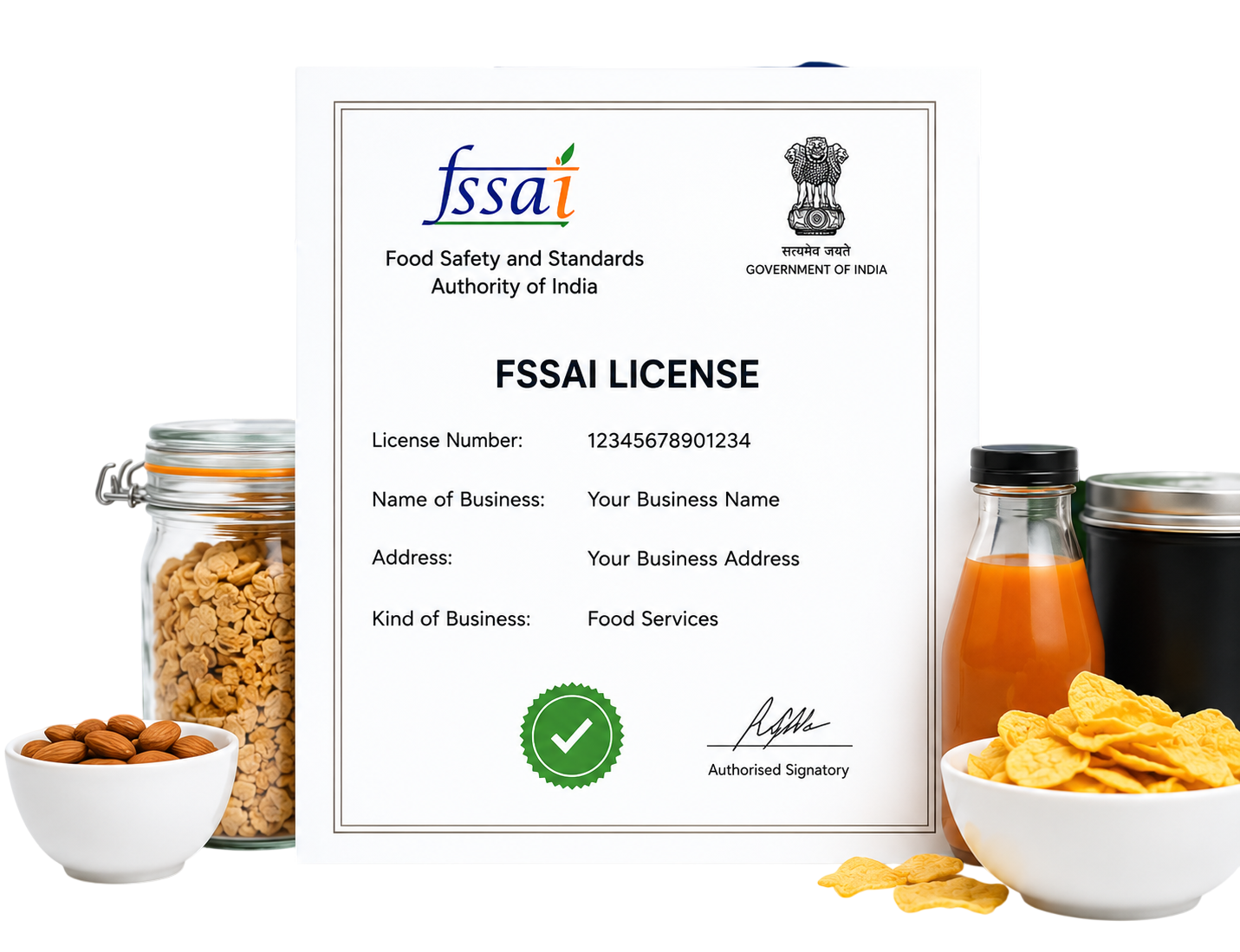
FSSAI License Registration Certificate in India

The FSSAI License Registration Certificate is an essential legal approval required for food businesses operating in India. It confirms that your business complies with the food safety standards and regulations prescribed by the Food Safety and Standards Authority of India (FSSAI).

Obtaining an FSSAI certificate not only ensures legal compliance but also enhances customer confidence, business credibility, and market reputation.

With the professional support of TaxBizLegal, you can complete your FSSAI Registration or License process smoothly and without complications. Our experts assist you with documentation, application filing, compliance, and timely approval so you can focus on growing your food business.

Get in touch with TaxBizLegal today and let our experts manage your FSSAI registration process efficiently and professionally.

Contact Us Today

Frequently Asked Questions

Find quick answers to common queries about FSSAI registration, food licenses, and compliance in India. Get your business started on the right foot.

Get Expert Help
What is FSSAI registration? +
FSSAI registration is a mandatory license issued by the Food Safety and Standards Authority of India (FSSAI) for all food businesses to ensure food safety and hygiene standards.
Who needs FSSAI registration? +
Any individual or business involved in manufacturing, processing, storing, transporting, distributing, or selling food products in India must obtain an FSSAI registration or license.
What are the different types of FSSAI licenses? +
There are three types: Basic Registration (turnover up to ₹12 lakh), State License (turnover ₹12 lakh to ₹20 crore), and Central License (turnover above ₹20 crore or specific operations like import/export).
How long does FSSAI registration take? +
The processing time typically ranges from 5 to 7 working days for Basic Registration, and 15 to 45 days for State and Central Licenses, subject to document submission and authority approval.
What documents are required for FSSAI registration? +
Common documents include identity and address proof of the applicant, business registration proof, address proof of premises, food product details, and a declaration form. Specific documents vary by license type.
Is FSSAI license renewal mandatory? +
Yes, FSSAI licenses are valid for 1 to 5 years and must be renewed before expiry to avoid penalties. Renewal applications should be submitted at least 60 days prior to expiry.
What are the penalties for not having an FSSAI license? +
Operating without a valid FSSAI license can lead to financial penalties up to ₹5 lakh, imprisonment up to 6 months, and suspension or closure of business operations.
Can I operate a home-based food business without FSSAI? +
No, even home-based food businesses, if they produce or sell food items, require at least a Basic FSSAI Registration. It's crucial for legal compliance and building customer trust.
What is the validity period of an FSSAI license? +
An FSSAI license can be obtained for a period ranging from 1 to 5 years, after which it needs to be renewed.
Can FSSAI registration be cancelled? +
Yes, FSSAI registration can be cancelled by the authorities if the business fails to comply with food safety standards, violates regulations, or provides false information.

Still Have Questions?

Our legal experts are here to help you navigate the process.

Chat on WhatsApp
Consult now WhatsApp
